
Table of Contents
Staying Within the Law
To bolster LEO Speedwagon’s international cooperation, the U.S. would seek to sign agreements, known as “reciprocal recognition,” with other space-faring nations that mutually recognize one another’s mining claims. There is precedent for this kind of agreement in U.S. law, since the early 1980s, related to mining of the deep-seabed (H.R. 2759, 1980); the US extended reciprocity to the U.K (Deep Sea Mining Act, 1981), Japan, France, and other countries. This legislation was written contrary to United Nations Convention on the Law of the Sea (UNCLOS) (1982), which deemed the deep seabeds as “the common heritage of mankind” and “for the benefit of mankind as a whole, irrespective of the geographical location of State” (UNCLOS, 1982). The US did not sign UNCLOS on a philosophical basis due to the phrase in the preamble, “contribute to the realization of a just and equitable international economic order which takes into account the interests and needs of mankind as a whole and, in particular, the special interests and needs of developing countries” (UNCLOS, 1982). Furthermore, the US did not sign the Agreement Governing the Activities of States on the Moon and Other Celestial Bodies (1979) (Moon Treaty) because it also contained a similar phrase in Article IV:
“1. The exploration and use of the moon shall be the province of all mankind and shall be carried out for the benefit and in the interests of all countries, irrespective of their degree of economic or scientific development. Due regard shall be paid to the interests of present and future generations as well as to the need to promote higher standards of living and conditions of economic and social progress and development in accordance with the Charter of the United Nations.”
as the preamble in UNCLOS (Moon Treaty, 1979). The US and other like-minded States have entered bilateral, or multinational, agreements to avoid harmful interference and competing claims to resources; signatories to UNCLOS do not recognize the right of “reciprocal recognition.” Given that the US and other countries have entered into such agreements outside of UNCLOS, historical precedent has been set for other States to opt out of important international treaties and produce domestic law that suits their needs.
Finding and Harvesting Resources
Carbonaceous chondrites are an ideal candidate for far future missions because they did not heat up enough to begin to dehydrate and thus contain some percentage of water ice. These asteroids are common in the mid-asteroid belt. M and E class asteroids however, have hydrated minerals as they tend to be a bit closer than the dewline. Dewline defines the ice and liquid heliocentric distance within the current asteroid belt.
Jones et al. (1990) observed 19 low-albedo objects, mostly of the C class and subclasses. They determined that the fraction of hydrated asteroids decreased with increasing semimajor axis from the middle of the asteroid belt outward. C, B, G, and F asteroids have been proposed as comprising an alteration sequence (Bell et al., 1989). These subclasses all have different amounts of hydrated minerals, ranging from the ubiquitously hydrated G asteroids (all six observed have a feature) to the mostly anhydrous F asteroids (one of five hydrated). One caveat to 3-µm band detections is that they generally arise from the outer few tens of micrometers of the surface material, where fluid inclusions are unlikely, and only a minor contribution at best compared to the presence of phyllosilicates in the regolith. (O’Keefe, 2015).
Compositional considerations aside, another important consideration that further constrains the number of available objects is accessibility. Objects that require a very low “delta-v” would be ideal, as it would require small amounts of energy to capture (Kuroda, et al., 2014). At present taking objects from the main-belt (or beyond) would be impractical, if not nearly impossible. The upcoming OSIRIS-REX mission aims to study an object (101955 Bennu), which could conceivably hold up to a few million tons of water (Valentine, 2016). Despite water-rich objects being an extremely small part of the NEO population, a few relatively large objects might be all that is needed to do orbital resupply for the next few hundred years, if not more.
In the future more materials may be extracted from asteroids. Many terrestrial resources, like precious metals may run out. As new terrestrial sources are sought, materials are obtained at increasing economic and environmental cost (Ross, 2001). Mining asteroids maybe provide a partial solution to this problem. The metals that we are looking for are in the Pt-group, they include copper (Cu), palladium (Pd), silver (Ag), iridium (Ir), platinum (Pt), and gold (Au). The reason why these metals are so precious is because many of these metals are used in semiconductors that are higher marketed in space photovoltaics industry (Ross, 2001). Space mining could entail capitalization of a $1 trillion or more. Some of the metals can sell for over $10,000 per kg like platinum and gold, see Table 3 for a breakdown of precious metals value (Ross, 2001).
We must also discuss the engineering challenges that we will face when harvesting the asteroid. Once rendezvous and docking has been achieved the actual mining, extraction, and processing of the minerals begin. The method will depend heavily on what minerals can be extracted. For our project’s objectives we are aiming to extract the volatiles from the surface regolith which will require a different method than mining from the core. Loose material from the surface can be scooped, scraped, or shoveled. Any frozen volatiles on the surface would have to be mechanically mined, cut, vaporized, or melted for extraction.
Surface mining seems to be the most promising and our group proposes to use a classical three-drum slusher/scraper that would work well on the Moon. However, this approach presents several problems on an asteroid to include: (1) very low strength regolith, (2) zero gravity, and (3) need for containment. This unique environment will force us to come up with a scraper or shovel that is held against the surface and ensure the collected material is retained within the collecting mechanism and will not float away (Brophy et al, 2012).
With surface mining presenting such challenges, it may be worthwhile to investigate underground extraction. The reasons for underground extractions is that it is easier to generate reaction forces for cutting, drilling, or digging, the surface layer may be depleted in the desired material, it may be easier to contain the cut or released material, and the void volume could be useful for storage or habitation (Brophy et al, 2012).
There are also several benefits from conducting a mission of this caliber. The first benefit from the return of an entire NEA is the synergy with near-term human exploration. The outcome could increase the search for smaller and more accessible NEA targets, the development of a deep-space crewed spacecraft and heavy-lift launch system, more robotic spacecraft and probes designed to characterize the properties of NEAs, and a scout mission to the likely human target to enhance safety and enable detailed mission planning (Brophy et al., 2012). The second benefit is the expansion of international cooperation in space. The demand for samples for engineering and scientific study of the carbonaceous chondrite material by academic, governmental, and industrial laboratories will be high. Select spacefaring nations would have access to the body while nations without the ability to fly missions to the body would be encouraged to form teaming arrangements and propose jointly with those who can access it (Brophy et al., 2012). The third benefit is an asteroid return mission would bring broader attention to the subject of NEA; therefore, greater understanding and attention to the planetary defense challenge. From a technical standpoint an asteroid return would enable progress in numerous areas of an anchoring, structural characterization, dust environment, and proximity operations (Brophy et al., 2012).
Remaining in Orbit
For reboosting the station, the aforementioned technology that the ISS uses currently could be transferred over. Different factors are involved in the design of the ISS propulsion system. The attitude control system provides the Station altitude, velocity vector changes and reboost for assembly operations. Also, the Reaction Control System (RCS) will be used to perform attitude maneuvers and control during reboost. The RCS are thrusters used for maneuvering and control of the Station. These RCS are based on the Space Shuttle RCS engines. However, Orbital Rotational Unit (ORU) thruster pods to the structure of the Advance Communication Tower (ACT) could be added to provide additional roll control of the ISS (Medina, 2000). The reboosting capabilities of the International Space Station are structured in three different modules and spacecraft: Zarya (Functional Cargo Block), Zvezda Service Module and Progress M Spacecraft. These 3 components are used to correct the attitude of the ISS. The attitude control engines are used in correcting the ISS altitude and recovering from orbit decay due to atmospheric drag.
There are two different components to the fuel used: N2O4 and UDMH. UDMH (unsymmetrical dimethylhydrazine H2NN(CH3)2) is stable and easily storable and used in hypergolic liquid for many rocket propellants. It is usually paired up with N2O4 (dinitrogen tetroxide), which acts as the oxidizer.
| Formula: N2O4 | Formula: H2NN(CH3)2 |
| Molar Mass: 92.011g/mol | Molar Mass: 60.1 g/mol |
| Density: 1.44 g/cm3 | Density: 793 kg/m3 |
| Melting Point: 11.84° F (-11.2° C) | Melting Point: -72.4° F (-58° C) |
| Boiling Point: 69.98° F (21.1° C) | Boiling Point: 145.4° F (63° C) |
In the future, consideration must be given to this reboosting system, as the fuel would require an outside supply. To allow for the uncrewed nature of this refueling station to remain, the reboosting system must be converted to allow for use of the liquid oxygen and liquid hydrogen fuel being created on the station itself. In contrast, the reboosting system could also be converted to allow for new types of propulsion, such as those that use electricity.
One possible option for keeping the station in orbit is using the VASIMR system or Variable Specific Impulse Magnetoplasma Rocket (Figure 14). VASIMR is an electric thruster that uses gas injected into a tube surrounded by a magnet and a series of two radio wave (RF) couplers. The couplers turn cold gas into superheated plasma and the rocket’s magnetic nozzle converts the plasma 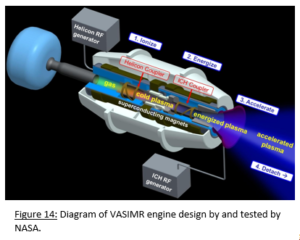 thermal motion into a directed jet (Ad Astra Rocket Company, 2009). VASIMR would use solar panels for a power source in the reboosting efforts of keeping the station in orbit. An electric power source is used to ionize fuel into plasma. Electric fields heat and accelerate the plasma while the magnetic fields direct the plasma in the proper direction as it is ejected from the engine, creating thrust for the spacecraft. The engine can even vary the amount of thrust generated, allowing it to increase or decrease its acceleration. It even features an “afterburner” mode that sacrifices fuel efficiency for additional speed (NASA Explores, 2015). A significant positive advantage to using VASIMR is that it would use hydrogen gas for propulsion, which is already stored on board the station. This would remove the necessity of another fuel supply, therefore reducing the cost of maintaining the station overall.
As an alternative, final conceptual idea, for reboosting the station LEO Speedwagon could utilize COMET-1 water thrusters that Deep Space Industries has developed for their Prospector spacecraft, and enlarge it to be used for the station. The science and technology is there, but the engineering would need to be expanded to support a large space station. This would also eliminate the need for external fuel storage since it uses water for its thrusting. It could be developed and implemented for reboosting and maneuvering the station to adhere to the minimalistic desire of the space station.
Navigation
Phase Four
Conclusion
Home