
Table of Contents
Proof of Concept of Extraction Operations
LEO Speedwagon’s first objective is to demonstrate water ice extraction from a small asteroid. Our group seeks to draft a Memorandum of Understanding (MOU), or assumption of liability, to negotiate terms to demonstrate our extraction process on NASA’s “asteroid” (more boulder like given it will be only 6 meters in diameter) placed in cislunar orbit for its Asteroid Redirect Mission (ARM).
For the purposes of this mission, the LEO Speedwagon’s team will collaborate as a partner on NASA’s ARM mission. If the “asteroid” recovered is a class C asteroid of the G sub-type, demonstrating the extraction process can be accomplished. Fornasier et al. (2014) indicated that 100% of G subtype asteroids analyzed in the study are the most likely to contain hydrated minerals, maximizing the probab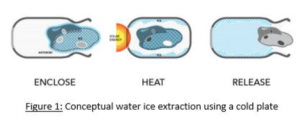 ility of finding water as well as the potential water volume collected. They make up about 20% of the known population, but since their albedo is low, they may be heavily biased against detection in optical surveys. C-type asteroids are easy to cut or crush because of their low mechanical strength,and may yield as much as 40% by mass of extractable volatiles (Brophy et al., 2012). Several options exist to either manufacture a new extraction spacecraft, lease an existing extraction spacecraft, or purchase a spare extraction spacecraft from established space mining companies such as Deep Space Industries or Planetary Resources. The spacecraft would need to be equipped with a cold plate large enough to enclose the ARM “asteroid” and trap the gaseous water when releasing or departing the “asteroid” (Figure 1) (Planetary Resources, n.d.). If LEO Speedwagon is unable to acquire/lease an extraction spacecraft from an existing space mining company, then the team will take competitive bids from commercial spacecraft manufacturers (Boeing, Lockheed-Martin, Ball Aerospace, Space Systems/Loral, etc.) to create a new, unique design to accommodate this mission.
If the “asteroid” is not of a G subtype, or does not prove to contain enough extractable hydrated minerals, then LEO Speedwagon will partner with California Pol ytechnic State University’s (San Luis Obispo, California) Cubesat or Polysat Team to develop a 3U (10 cm x 10 cm x 30 cm) cubesat (Figure 2). This cubesat will contain a partially-filled, small (1 kg) propellant tank to emonstrate the refueling process. The propellant tank will have enough fuel to conduct maneuvers to rendezvous with the refueling platform (to be 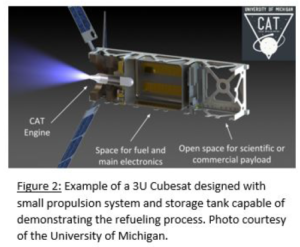 discussed in Mission Objective Two). The estimated cost of developing this cubesat can be up to $350K (Heyman, 2009; Cal Poly Cubesat, personal communication, February 17, 2017). As previously stated, ideal objects to harvest would be “water-rich” objects, rather than objects nearing a 100% Iron-Nickel composition. At present, several asteroid surveys have collected enough data to give rough population estimates for small bodies in our solar system (Binzel et al., 2010; Elvis et al., 2013, Kuroda et al., 2014). Given the existing research, and relative ease of adding an “off the shelf” spectrometer, the cubesat could demonstrate the technology LEO Speedwagon will use to prospect Near Earth Asteroids (NEAs) for hydrated minerals when large-scale operations are required. During the “survey” phase, the cubesat would look for absorption features in the 0.4–0.9 μm , and 2.4–3.6 μm regions – both of which are “tell-tale” signatures for hydrated minerals. The specific compositions of said minerals are silicates, non-silicates, brucite, goethite, carbonate hydromagnesite and sulfide tochilinite.
The percentage of objects in low-albedo, outer main-belt asteroid classes that exhibit hydrated mineral signatures increase from P → B → C → G class and correlate linearly with increasing mean albedos (Vilas, 1994). In general, “water-rich” asteroids at some point experienced heating event(s) which melted internal ice reservoirs, which drove aqueous reactions, resulting in hydrated mineral deposits. Hiroi et al. (1996) found that the best matches to the spectra of large C-class asteroids in the 3-μm region were unusual thermally metamorphosed CI/ CM chondrites. One alternative to adding spectrometers to the cubesat project would be to use existing data sets such as GAIA (Delbo et al., 2012). After successful demonstration of the extraction process has been achieved the project can transition into the sub-objective of safely storing and transporting the extracted minerals to a stable orbital position in LEO. The purpose of this sub-objective is to demonstrate the safe storage (without leaks) and to simulate the duration of travel from a NEA to LEO. The extraction spacecraft would require a water thruster, which would use water extracted from the asteroid to be used as a propellant for the trip back to the refueling platform (Deep Space Industries, n.d.). However, the best LOX/LH2 only have an Isp of 450 secs. Given this limited efficiency it would require 40 tons of propellant at the Near Earth Asteroid (NEA) and significantly more propellant to deliver this propellant mass to the NEA (Brophy et al., 2012).
If we are to assume that Deep Space Industries will be supplying the prospectors for the refueling station, their current prospector, Prospector-1, uses a COMET-1-300/750 water thruster for maneuvering. This water thruster, 300, has a specific power of 2.52-2.8 W/mN, specific impulse of 150-175 s and volume of 1.5U CubeSat. Nominal power consumption is only 0.25 W at idle, and 10 W when thrusting. The maximum amount of power consumption is 25W. The COMET-1-750 is slightly larger with a volume of 2.5U CubeSat and specific impulse of 175-200 s, but has the same specific power. Its nominal power consumption is also the same, though it has a larger maximum power consumption of 100 W. Deep Space Industries harvesters will also use the COMET line of water thrusters for navigation.
Another propulsion system to consider is ion propulsion because of its high specific impulse, 4100-4200 isp, (Goebel & Katz, 2008; Schmidt, Patterson, & Benson, 2008) and its reduced reliance on propellant as opposed to chemical propulsion systems (Patterson, 2016). Ion propulsion was first investigated by NASA as early as 1956. The first spaceflight test of an ion thruster was from SERT I in 1964, which was intended to 1) investigate the feasibility of neutralizing an ion beam with the addition of electrons, 2) demonstrate the thrust-producing capability of ion rockets, 3) provide data on the signal-generating characteristics of an ion rocket, and 4) prove the overall feasibility of ion rocket (Patterson & Sovey, 2013). The satellite was able to perform 30 mins of operating its new thrust engine. A big breakthrough in ion propulsion came in the 1980’s when NASA began to replace ion thruster from mercury and cesium to inert gases like xenon, krypton, and argon (Patterson & Sovey, 2013). The reasons for this change are that these gases provide simple startups and simplify power processing, are non-contaminating to spacecraft systems and science measurements, and are non-toxic. The propellant mostly used is xenon because of its dense gas at moderate pressure of 58.4 bar at room temperature (Sellers, 2007).
Ion propulsion allows the extraction spacecraft to travel at speeds up to 90,000 mph, or 145,000 kph (Szondy, 2013; Patterson, 2016). The Dawn spacecraft was able to reach a ΔV of 11 km/sec while the fastest post-launch chemical ΔV was the Magellan to reach 2.7 km/sec (Brophy et al., 2012). According to Hasnain, Lamb, and Ross (2012), if asteroids 1999 RA32 and 2008PG2 were targeted candidates, then conducting the real-world extraction, storage, and transport would require between 2.3 and 4.8 years for a round-trip mission. This indicates extensive testing on whether the structural integrity of the spacecraft will survive the long transit through space. It also suggests that the propulsion system will need to be designed and tested to ensure continuous operation without failure. NASA is involved in work on two different ion thrusters: the NASA Evolutionary Xenon Thruster (NEXT) and the Annular Engine. NEXT, a high-power ion propulsion system designed to reduce mission cost and trip time, operates at 3 times the power level of NSTAR and was tested continuously for 51,000 hours (equivalent to almost 6 years of operation) in ground tests without failure, to demonstrate that the thruster could operate for the required duration of a range of missions (Patterson, 2016). Since NASA has already conducted tests on ion propulsion systems to ensure long-duration operations without failure (Saulus, 2013), there is no need to test this aspect of ion propulsion systems. Successful testing of the storage capability of our spacecraft can be accomplished by launching a basic spacecraft with a large, 2000 kg tank with the intent to leave it in LEO. The “fuel tank” can remain in a stable orbit until all technology demonstrations have been successfully conducted and the availability of a refueling platform has been determined. This time frame would ideally be 20 years, so it could fulfill mission requirements in obtaining materials, balancing the budget and testing the equipment’s capabilities.
Following Space Mining Law
LEO Speedwagon has reviewed the pertinent space law regime and is committed to complying with current international space law. Any space mining activities conducted on celestial bodies by the entity which owns the refueling station will abide by OST Article II, “Outer space, including the Moon and other celestial bodies, is not subject to national appropriation by claim of sovereignty, by means of use or occupation, or by any other means.”
Article VI,
“States Parties to the Treaty shall bear international responsibility for national activities in outer space, including the Moon and other celestial bodies, whether such activities are carried on by governmental agencies or by non-governmental entities, and for assuring that national activities are carried out in conformity with the provisions set forth in the present Treaty. The activities of non-governmental entities in outer space, including the Moon and other celestial bodies, shall require authorization and continuing supervision by the appropriate State Party to the Treaty. When activities are carried on in outer space, including the Moon and other celestial bodies, by an international organization, responsibility for compliance with this Treaty shall be borne both by the international organization and by the States Parties to the Treaty participating in such organization.”
Article VII,
“Each State Party to the Treaty that launches or procures the launching of an object into outer space, including the Moon and other celestial bodies, and each State Party from whose territory or facility an object is launched, is internationally liable for damage to another State Party to the Treaty or to its natural or juridical persons by such object or its component parts on the Earth, in air space or in outer space, including the Moon and other celestial bodies.”
and Article VIII,
“A State Party to the Treaty on whose registry an object launched into outer space is carried shall retain jurisdiction and control over such object, and over any personnel thereof, while in outer space or on a celestial body. Ownership of objects launched into outer space, including objects landed or constructed on a celestial body, and of their component parts, is not affected by their presence in outer space or on a celestial body or by their return to the Earth. Such objects or component parts found beyond the limits of the State Party to the Treaty on whose registry they are carried shall be returned to that State Party, which shall, upon request, furnish identifying data prior to their return.”
The approval of House of Representatives (H.R.) 2262, United States Commercial Space Launch Competitiveness Act, or Public Law No. 114-90, on 25 November 2015 marked historic U.S. domestic legal protection for space mining companies. The US provided legal protection of its commercial space industry to prospect, extract, and return minerals from a celestial body without national appropriation by claims of sovereignty (H.R. 2262, 2015). This act authorized commercial recovery of resources free from harmful interference while under jurisdiction of the federal government (H.R. 2262, 2015). Currently, only commercial launch and reentry activities are regulated by the Office of Commercial Space Transportation under the Federal Aviation Administration, which is part of the Department of Transportation. This could be subject to change as Congress has multiple draft bills several members of the Space Subcommittee of the House Science, Space, and Technology Committee have championed.